
Starting a Roll-Off Business the Right Way
The roll-off business: It could be a gold mine—or a money pit. It all comes down to market opportunity, entrepreneurial spirit, and investing in the right assets—at the right time.
Want to know how to start a roll-off dumpster rental business?
Your business success hinges on the thoughtful research and planning you do right now. That means:
- Conducting market research to ensure the opportunity is there
- Identifying your niche in the marketplace
- Calculating your roll-off operating expenses
- Exploring safety and compliance regulations and costs
- Estimating your start-up capital expenses
- Marketing your roll-off rental business
- Building partnerships that will sustain your business
- Protecting yourself from customers who don’t pay their bills
- Expanding your operation with complementary services
Ready to dig in? Let’s go.
Research your local dumpster rental market
Before you start a roll-off business, it’s critical to understand how many competitors are already operating in your prospective service area, the services they offer, what they charge, and whether or not customers are unhappy with them.
This early competitive research will help you discover if there’s room for you in the market—and whether you can carve out enough margin to run profitably.
To start:
- Search “dumpster rental near me”
- Document each business in your prospective service area
- Capture their Google star ratings, and read their poor reviews for hints at how you might deliver a better offer
- Look them up on the Better Business Bureau website; make note of low ratings and complaints
- Review their websites and capture their services, dumpster sizes, and target audiences
If there’s a pool of unhappy customers out there, you might be able to dazzle them with outstanding service.
In fact, when going up against the big guys, this is where small local businesses often shine—friendly, responsive, guy or gal next-door service.
Next step: Give each of those roll-off businesses a call, and add what you learn to your research document, including:
- How quickly they can deliver a dumpster to a job site
- Their dumpster rental rates
This insight will help you determine if there’s a niche you can fill, and if there’s room for you to operate profitably.
Finally, we recommend that you complete a SWOT analysis. This means, identifying the strengths and weaknesses of your prospective business—and the opportunities for and threats to its success. This exercise can often help illuminate whether or not launching a new business is wise.
A roll-off business is an inexpensive way to gain entry into the waste management industry—provided there’s a place for you to grow. Is your area underserved? Doing this gumshoe detective work will reveal that answer.

Identify your niche in the dumpster rental market
Through careful market research, you’ll uncover competitive opportunities and underserved needs in your prospective service area, like:
- Faster turnaround times
- Better customer care
- Targeted services for specialized business needs
For instance, these audiences could prove to be profitable dumpster rental customers:
- Real estate agents who need to prep foreclosed properties for market
- Landlords who want to clear our tenant debris from their rental properties
- Roofers, remodelers, small to mid-sized construction contractors, and even do-it-yourselfers who need to dispose of construction and demolition debris
- Landscapers who want to clear yard waste and landscaping material from job sites
We often hear from small construction and landscaping contractors that operate in areas serviced by a single, major hauler. They’re exploring what it might take to claim a piece of the roll-off pie.
If that’s the scenario in your area, there’s a niche market for you. Why?
- Big haulers are after the big contractors—they want 100 pulls a month from a single customer
- Small businesses want to work with other small businesses
- By operating with smaller equipment, you can get into cul-de-sacs and drop boxes in residential areas without tearing up property
Estimate your roll-off business operating expenses
When determining what it will cost to operate your dumpster rental business, you’ll need to estimate:
- Truck license fees
- DOT number fees
- Liability insurance costs
- City, municipality, and DNR permit costs
- Truck and roll-off equipment maintenance costs
- Fuel costs
- Tipping fees for construction and demolition debris (C&D), as well as for regular trash—they’re often priced differently
- Staffing costs, should you plan to hire a driver or someone to answer your phone at the outset
- Marketing costs, like business cards, a website subscription and hosting, digital advertising spend, and a Chamber of Commerce membership
Explore safety and compliance requirements and costs
When you inquire about permits, the cities and municipalities you speak with will help you understand their local environmental regulations. Through this process, you’ll learn a lot about what you can put where. For example, some landfills won’t take your shingles and drywall, and incinerators will be really unhappy if you slip metals into your load.

As for safety, check out your state regulations for guidance. OSHA is available, too, but online state and local resources are typically easier to navigate. Find out what they require.
It’s important that you explore your compliance requirements, costs, and fines early. They’ll help you determine if it’s worth going into business.
Estimate dumpster rental startup capital costs
Begin by searching for used roll off equipment listings and getting estimates for new equipment from reputable manufacturers. This data will help you determine if you can deliver competitive rental rates, while also generating the profitability you need to grow. For many, going the high quality used equipment route can be a great way to get a dumpster rental business off the ground.
The good news: Solid used equipment is out there. In fact, when our customers upgrade their equipment, they list their used equipment with us. (This is a free service we offer to our customers, and you work directly with the seller.)
But perhaps you’re confident the market is ripe, and you want to purchase new equipment right out of the gate.
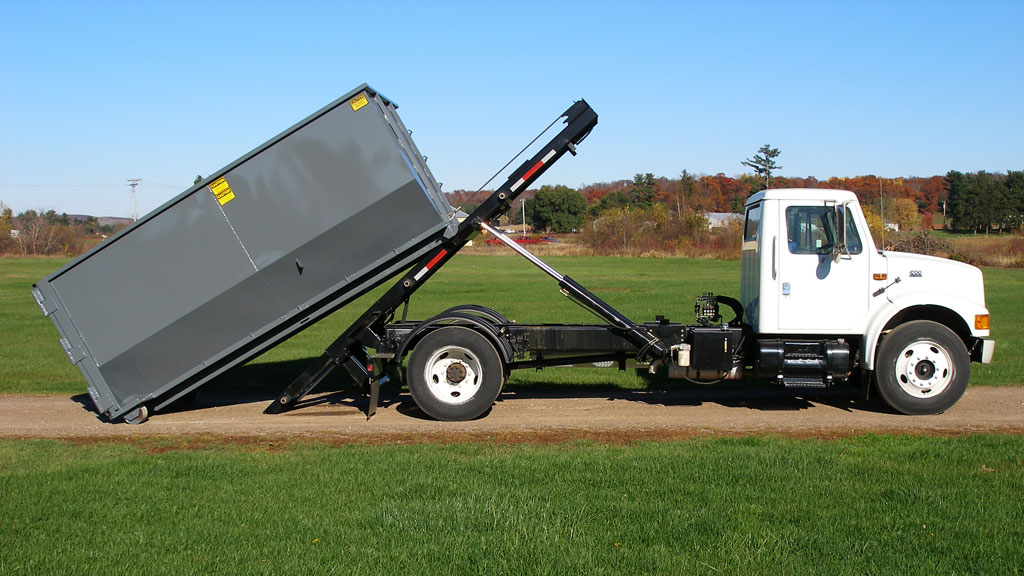
A word of warning: cheap, starter roll-off packages are out there, and they’re targeting people just like you. Often poorly constructed with non-industry-standard rails, they keep you locked into their low-quality dumpsters for as long as you’re running their system.
It’s an expensive mistake.
When you purchase a rolloff trailer, we urge you to opt for one with industry-standard rails. When you do, you’ll be free to shop the market and jump on a great deal when someone else is going out of business.
Another thing to consider as you shop for a trailer: If you go with a smaller system, like a 16,000 lb trailer, not only will you be able to haul dumpsters with a ¾ ton pickup truck, you won’t need a CDL either.
And, the smaller containers you haul will take up less space in driveways and be far less likely to damage property than the big boxes national haulers deliver—making for happier customers.
We find that a 16,000 roll-off trailer is a great fit for dumpster rental start-ups.
Now, as you’re calculating these equipment costs, be sure to roll replacement costs into your big-picture calculus. Some equipment simply won’t offer the same longevity as equipment that’s solidly constructed, costing you more money in the long run. So, factor that in if you go the cheaper route to get your business off the ground.
Finally, as you’re researching roll-off equipment manufacturers, be sure you work with one that can support rapid scaling. If your business takes off and you don’t have enough containers to support demand, you’ll have to turn business away.
Now, can you afford to make the leap?
Before you answer that question, keep in mind that new business owners typically don’t get paid in those first few years. Profits are instead invested in the business to drive growth. Can you sustain that?
Market your rolloff dumpster business
Visibility is critical to your business growth. That means building a smart digital presence, as well as marketing your business with physical methods. Some smart approaches to consider right out of the gate:
- Create a free Google Business listing—and be sure to request reviews from your happy customers
- Build a simple website that clearly communicates your services, service area, and why customers should do business with you—add customer testimonials for valuable social proof when you have them
- Launch social media channels to share customer stories, special offers, new partnerships, community engagement, and other business updates
- Print branded decals for your truck and roll-off dumpsters
- Purchase yard signs to promote your services from customer locations
Unfortunately, this work is becoming even more challenging as AI shifts the way we search and chooses which businesses to display in AI answers.
You can help deliver the trust and authority signals AI is looking for by:
- Matching your business name, phone number, and address format across all of your digital channels
- Sharing a consistent value proposition message
- Publishing leadership bios that convey your expertise
- Sharing your first-hand experience on your website, social media channels, and forums, like Reddit (though never directly sell there)
- Publishing custom photography (uncluttered, well-lit photos shot with your mobile device are fine!)
- Adding policies to your website, like privacy, service guarantee, and terms of service policies
Build partnerships that will sustain your roll-off business
Business is all about building relationships—especially at the local level. Begin reaching out to the niche audiences you’ve identified, and let them know you’d like to be their vendor. These are small businesses, and they’ll be loyal to local people—just give them a fair deal.
Keep in mind that happy, recurring customers can often be an important source of referrals, so be sure you consistently deliver friendly, responsive service.
An important point: Don’t complicate your business with deep contracts filled with confusing legalese. It frustrates small businesses, and it’s what they often encounter with the national haulers—huge, confusing contracts that feel as though they’re signing their lives away.
Lastly, don’t overlook your partnership with landfill operators. A great partnership is guaranteed to help your bottom line. Once you’ve built a solid rapport, you may be able to negotiate per-ton rates, which are savings you can pass along to your customers—making you an even more competitive option.
Protect yourself from dumpster rental customers who don’t pay up
Unfortunately, you’ll run into a bad customer from time to time. That’s why it’s important to get a valid credit card up-front, and be sure to charge an extra fee to cover your credit card processing costs (~5%). That way, you’ve protected your business.
Because, once the waste is on your truck, it’s yours.
A customer once called us in frustration to say that, after non-payment, he hauled the waste back to his customer’s lot and dumped it in their yard. Well, the hauler got ticketed, sued, and was on the receiving end of negative press coverage—and then he was court-ordered to return to the lot, clean up the waste, and pay out of his own pocket to dump it. Talk about a raw deal.
The customer got free service because the hauler didn’t have a valid credit card. Don’t let this be you.
Expand your roll-off business with complementary services
Consider how you might offer complementary, diversified services. Not only can they help you carve out a competitive advantage, but they can also help you safeguard your business from an unforeseen economic downturn.
The best way to identify these opportunities? Listen to your customers. Understand their needs.
For example, have you considered delivering portable restrooms to your construction clients? What about offering hazardous waste disposal as a way to open up a new stream of recurring business?
One of our roll-off customers ordered a custom dump body, auger, and plow. His snow removal services proved to be a great way to supplement revenue in the slow winter months.
Good luck
There’s opportunity out there for many. Just remember—if you choose to make the leap, the greatest value you can provide your customers is excellent service.
You don’t need to get too carried away competing with your competitors on price. Simply research the industry averages for pricing in your region and set your prices low enough to make a profit after covering your costs.
Then, deliver the friendly, responsive, reliable service that keeps them coming back time and time again. It’s the surest way to grow.